
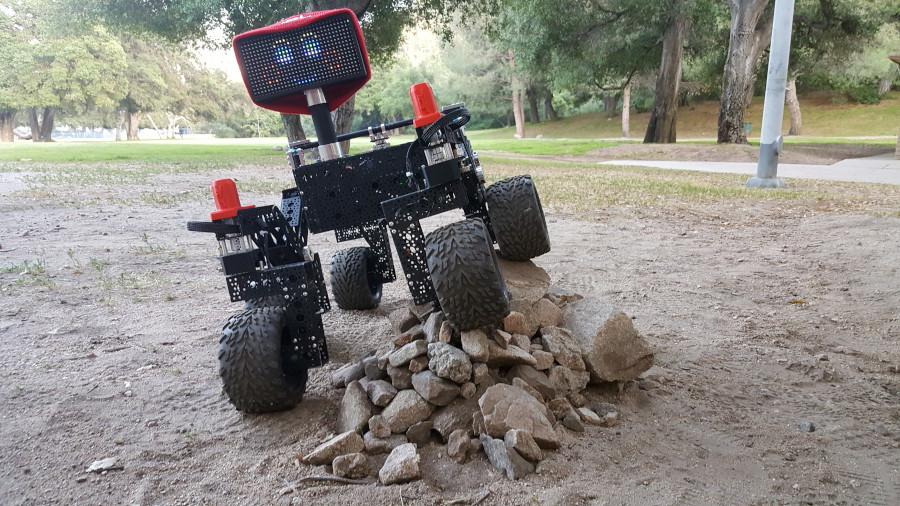
With all of the public excitement surrounding NASA’s Curiosity rover, the folks at Jet Propulsion Laboratory created a way to bring the experience of driving a rover to the public. JPL created and released plans for a small-scale version of their rover that can be built by individuals or school groups. The plans for this mini rover are freely available online and include everything from mechanical diagrams to the code needed to build it.
At the heart of the rover is a Raspberry Pi 3, familiar to most people in the electronics and robotics community. The scaled-down rover uses a rocker-bogie suspension, just like the full-sized version. The six foam rubber wheels are driven by 378:1 gearmotors with integrated encoders. Four of the wheels are used for steering and use 172:1 gearmotors, also with integrated encoders. The drive and steering motors are controlled by five RoboClaw 2x7A motor controllers. The Raspberry Pi works with the RoboClaw’s packet serial mode to communicate with the controllers.
The chassis uses ServoCity’s aluminum plates and channel, which means no custom metal fabrication is needed. In fact, all of the parts except for two body plates and a handful of circuit boards are off-the-shelf components. The non off-the-shelf parts can be sent out for fabrication at minimal cost, and the design files you need to submit are included in the plans.
The rover features a 16×32 color LED matrix that can display custom messages and images of the user’s choice. Remote control uses either an Xbox 360 controller or an Android phone or tablet.
The video below shows an early version of the rover on display. RoboClaw is suitable for a wide range of motor control projects, and this rover is just one application.
Where the Project Is Today
Since this article was first written, the rover has been through several major revisions. The current version redesigns the electronics around a custom two-board set that carries three RoboClaw controllers, driven by a Raspberry Pi running ROS 2. In other words, the project still runs on RoboClaw motor controllers, configured with BasicMicro Motion Studio, and remains an off-the-shelf, build-it-yourself design. The clip below shows a current-generation rover out for a drive.
Next Steps
The project’s plans, documentation, and code are all freely available:
- Open Source Rover homepage, including a browser-based rover you can drive.
- Open Source Rover on GitHub, with the full plans and build documentation.
Building your own rover, or another robotics project? See Motor Controller Selection for how to match a controller to your motors.
