
To select a motor controller, it should be matched to the motor’s operating voltage, running current, and stall current. Ideally the controller’s continuous rating should meet or exceed the stall current, since a motor can draw the full stall current at startup. Motor torque is proportional to current, so an undersized controller with current limiting still works, but caps the motor’s torque.
A motor controller that is too small for its motor will overheat, fault, or fail outright. This guide covers the three motor specifications that determine the right controller, how to estimate stall current when the manufacturer doesn’t publish it, and how to size a RoboClaw around it.
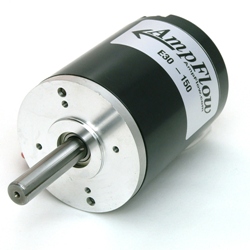
What Motor Specifications Matter?
A brushed DC motor has several specifications, three of which are key to properly pairing a motor controller.
The first specification is the motor’s operating voltage. The motor controller must be able to operate within the correct voltage range for the motor to avoid damage.
The second specification is running current. Typically this is the current required, at a specific voltage, to spin the motor at its maximum speed under no load.
The third specification, and the key one for pairing a motor controller, is stall current. Any brushed DC motor that is not rotating is in a stall condition, and the current it draws in that state is determined by the motor’s winding resistance and Ohm’s law, I = V/R. The stall current depends on the voltage the motor is operated at: the higher the voltage, the higher the stall current. A motor with a stall current of 100 amps at 12VDC will have a higher stall current at 24VDC.
How Do You Estimate Stall Current?
Manufacturers often do not publish a motor’s stall current and only provide the running current, leaving it up to the end user to determine it. If the winding resistance is published, the stall current can be calculated directly with Ohm’s law (I = V/R).
If the winding resistance is not published, it can be measured. Touch the multimeter probes together first and note the lead resistance, then measure across the motor terminals and subtract it. Brushed motor windings are often well under an ohm and the reading changes with brush position, so rotate the shaft slowly and take several readings, using the lowest. Because most multimeters cannot resolve very low resistances accurately, a better method for larger motors is to briefly apply a small known current with the shaft held still, measure the voltage at the motor terminals, and calculate R = V/I. Keep the test brief so the windings do not heat, since resistance rises with temperature.
When neither figure is available, rules of thumb give a workable estimate: small hobby motors typically stall at 3 to 5 times their rated running current, while high-torque gearmotors can stall at 7 to 10 times. It is not unusual for a motor’s stall current to be a full order of magnitude higher than its no-load current. When in doubt, estimate high.
This calculator requires JavaScript. Use Ohm’s law (I = V/R) or the multiplier rules of thumb above to estimate stall current.
Abrupt reversals can draw roughly 2× the stall current. A smaller RoboClaw can still run the motor using current limiting, at reduced torque.
How Do You Size the Controller?
Ideally, the motor controller’s continuous current rating should be greater than or equal to the motor’s stall current, with some margin on top. When that is impractical, the controller’s peak rating must at minimum cover what the motor actually draws in normal use, and that is more than many builders expect.
A common assumption is that a motor running at light loads can use a smaller motor controller. This is typically not the case. When starting from a standstill the motor can require its full stall current to start and spin; the starting load and operating voltage determine the maximum current required. Once the motor is spinning freely the current drops proportionally. However, if the motor’s direction is changed without a full stop, the current draw can reach nearly twice the stall current, because the voltage generated by the still-spinning motor adds to the applied voltage. Frequent starts, stops, and reversals under load are what push a controller past its ratings.
An undersized motor controller can be permanently destroyed by stall or reversal currents. Size the controller for the motor’s stall current, not its running current.
Prolonged stalls are hard on the motor as well. A stalled motor dissipates its full input power as heat in the windings and can burn out if the stall is sustained.
Sizing a Controller for a Real Motor
Consider a brushed DC motor with a stall current of 100 amps, a running current of 15 amps, and an operating voltage of 12VDC. The RoboClaw 2x30A has the running current to run this motor. However, since the 2x30A is only capable of 60 amps for brief periods, it may not be able to maintain the motor’s speed properly due to the total current requirements at startup and under load.
The RoboClaw 2x60A, rated at 120 amps peak for brief periods and 60 amps continuous, would be a more effective solution for this motor. The 2x60A can handle frequent starting and stopping along with sudden direction changes. The remaining limitation is the heat the motor controller generates, which is where adequate cooling becomes critical, especially if the motor is expected to run under heavy loads and change direction frequently.
Depending on load and voltage, the 2x60A may still be too small for this motor, and a higher current rated RoboClaw would be required.
Can Current Limiting Help?
Every RoboClaw supports user-defined current limits, set in Motion Studio. Setting a current limit at or below the controller’s rating lets a RoboClaw safely drive a motor whose stall current exceeds what the controller can supply. Because a brushed motor’s torque is proportional to its current, capping the current caps the torque: the motor will still run and can still reach full speed under light loads, but it will not deliver the full torque and power it is capable of during startups, heavy loads, and reversals. For applications that don’t need full stall torque, current limiting can make a smaller controller a safe choice. A 2x7A, for example, can effectively run a motor with a much larger stall current under these conditions. See RoboClaw Basics for more on the RoboClaw’s protection features.
Next Steps
With a controller matched to the motor, these guides cover powering and setting it up:


