
This application note covers using the Basicmicro Arduino library to read, set, and reset the encoders attached to a RoboClaw motor controller, with a complete example sketch demonstrating every encoder function.
Using Encoders with the Python Library
This application note covers using the Basicmicro Python library to read, set, and reset the encoders attached to a RoboClaw motor controller from a Raspberry Pi 3, 4, 5, or Zero, with pip install instructions and a complete example script.
Using the RoboClaw Python Library
The RoboClaw Python library is now the Basicmicro Python library, installed with pip install basicmicro. This guide covers installing it, the pattern for using it in a script, a complete working example, and a reference for the most commonly used functions.
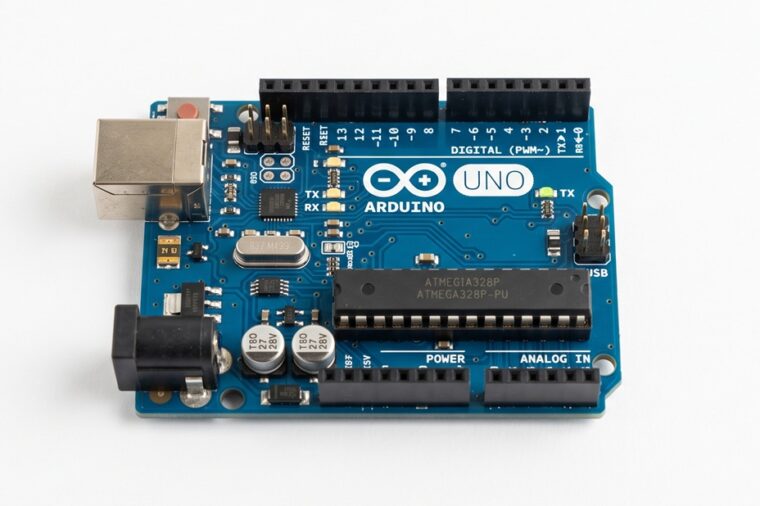
Using the RoboClaw Arduino Library
The RoboClaw Arduino library is now the Basicmicro Arduino library, available in the Arduino Library Manager. This article covers installing the library, the pattern every sketch follows, and the most commonly used functions for controlling RoboClaw and MCP motor controllers.

Packet Serial Bus Operation with the Raspberry Pi 3
Multiple RoboClaws can be used together for projects requiring more than one motor controller. This Application Note demonstrates the control of 4 RoboClaws by a Raspbery Pi using the packet serial control mode of the RoboClaw.

Standard Serial Bus with the Raspberry Pi 3
Multiple RoboClaw’s can be used simultaneously when controlled by a microcontroller or computer. The Raspberry Pi is one suitable choice. This Application Note covers using a Raspberry Pi 3 to control 4 RoboClaws in standard serial mode.

Standard Serial with the Raspberry Pi 3
This Application Note details how to operate the RoboClaw in standard serial mode using a Raspberry Pi 3. In standard serial mode the RoboClaw accepts single byte commands that control the operation of both motor channels.

Packet Serial with the Raspberry Pi 3
In this Application Note a Raspberry Pi is used to control a RoboClaw in packet serial mode. In packet serial mode the Raspberry Pi can send commands to the RoboClaw as well as read data from the it.

Configuring the Raspberry Pi 3 Serial Port
The Raspberry Pi 3’s GPIO serial port must be freed from the Linux serial console before it can talk to external hardware. This guide shows how to enable the UART and disable the console with raspi-config, or by editing the boot configuration manually.

Standard Serial Mode with Arduino
Control a RoboClaw motor controller from an Arduino using standard serial (Simple Serial) mode: wiring, Motion Studio configuration, and a complete example sketch that drives both motor channels with single-byte commands.